The senior actuary’s face said it all.
“We can’t even open the file.”
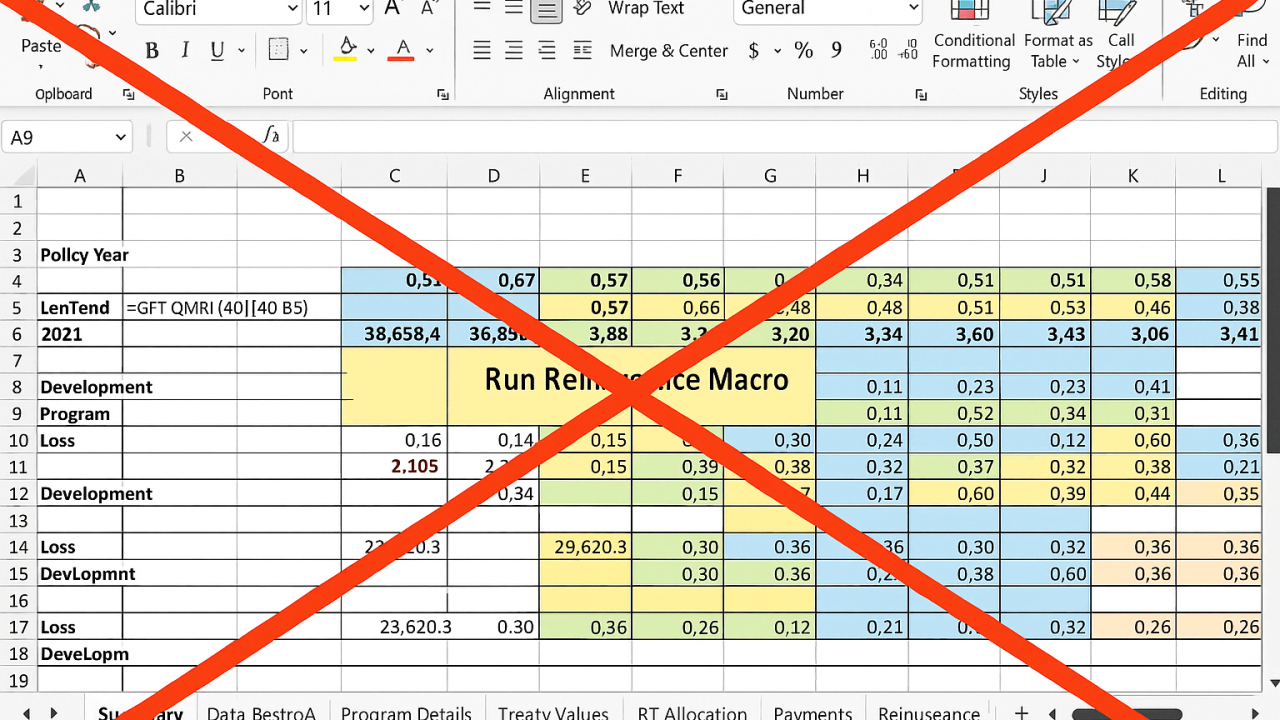
A Bermuda-based reinsurer had just won a significant treaty — always a big moment for any team. But now they faced a different problem. The cedant’s data was too large for Excel to process. What should have been a moment of triumph instantly became an operational crisis.
This scene plays out across the reinsurance industry with alarming frequency. Despite being one of the world’s most capital-intensive and data-driven sectors, too often, reinsurance runs on spreadsheets.
The hidden risks of spreadsheets
When we audit reinsurance operations, we consistently find critical processes trapped in fragile spreadsheet architectures:
- Settlement statements requiring days of reconciliation across multiple files
- Actuaries manually transferring data between modelling systems and Excel
- Pricing decisions flowing through undocumented formulas with no audit trail
- Key treaty assumptions buried in cells without version control
This creates real business risk. Spreadsheet errors lead to valuation mistakes. When key actuaries leave, critical knowledge goes with them, buried in personal workbooks no one else understands.
Excel has its rightful place in business — it’s accessible, flexible, and powerful for ad-hoc analysis. But what works for individual analysis breaks down catastrophically when used as enterprise infrastructure.
Three structural challenges keep reinsurers tied to Excel:
System Fragmentation — Reinsurers invest in specialised systems for actuarial modelling, finance, and asset management, but these systems rarely communicate with each other. The result: download data, manipulate in Excel, email to colleagues, reformat, upload somewhere else. People become the connective tissue between systems that should be technically integrated.
Talent Constraints — With Bermuda’s shortage of actuarial and technical talent, teams build quick solutions rather than sustainable ones. Creating another spreadsheet is faster than fixing underlying data flow problems. Until it isn’t.
Misaligned Priorities — While operations teams worry about efficiency, executives focus on pricing, yield, and BSCR optimisation. Without directly connecting data infrastructure to these priorities, improvement projects struggle to gain traction.
What smart workflows look like in practice
Forward-thinking reinsurers are taking a different approach — creating integrated ecosystems where data, systems, and workflows function as a coherent whole rather than disconnected parts.
We recently worked with a leading Bermuda-based reinsurer to transform their data architecture. Their approach centred on three key principles:
- Build once, use many times — Creating standardised data interfaces that accommodate variations within consistent frameworks
- Automate the predictable — Replacing manual reconciliation with automated validation and exception handling
- Preserve context, not just data — Maintaining metadata about who changed what, when, and why — creating institutional memory
The results were transformative. Processing times were dramatically reduced, key person dependencies were eliminated, and they created capacity to onboard new treaties without proportional headcount increases.
Smart workflows create compound benefits as your business grows:
- Operational leverage: Supporting multiple books with leaner teams
- Accelerated time-to-market: Significantly reducing treaty onboarding timelines
- Control environment strength: Automated validation eliminating reconciliation errors and strengthening regulatory compliance
- Capital optimisation: Better data visibility enabling more precise reserving and improved investment strategies
- Decision agility: Providing leadership with real-time portfolio visibility rather than delayed reporting cycles
Starting the transformation
The path from spreadsheets to smart workflows doesn’t require massive system overhauls. It starts with targeted interventions in high-value processes:
- Map the current state — Document how data actually flows through your organisation, identifying manual touchpoints and reconciliation bottlenecks
- Create structured data contracts — Establish consistent formats for key data elements that flow between systems
- Pick one high-impact process — Start small: settlement statements, valuation workflows, or treaty onboarding often offer clear ROI
Build for scale, not just speed — design solutions that work for multiple books, not just your current portfolio.
If you’re still pricing, reporting, or forecasting primarily in Excel, you’re not just behind, you’re exposed. While you’re contemplating transformation, your competitors are already acting.
Toucanberry specialises in helping Bermuda reinsurers build operational architecture that scales without proportional headcount growth.