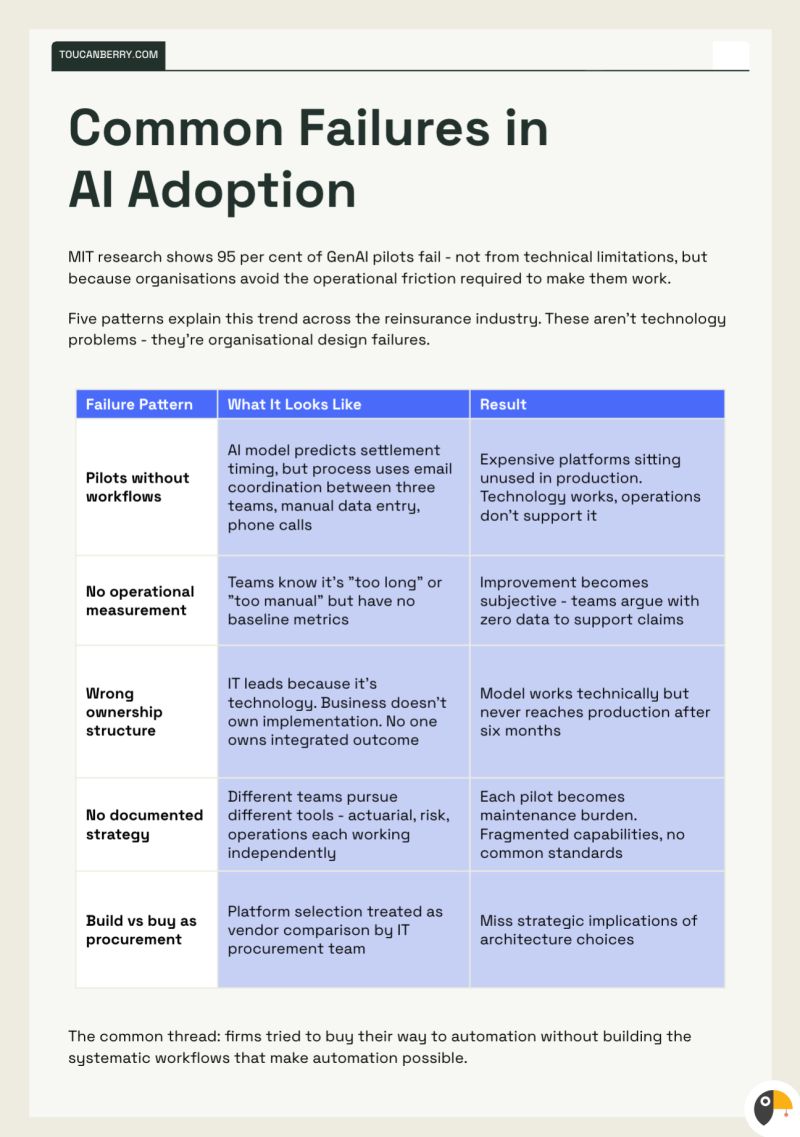

Last week, we explored why most reinsurance technology initiatives fail to meet their business goals. We identified three critical disconnects: starting with systems instead of workflows, confusing outputs with outcomes, and hiding operational complexity.
So what’s the alternative?
How to actually fix it
This isn’t a technology problem. It’s something fundamentally much simpler and yet harder to achieve — approaching transformation from first principles.
1. Don’t build systems. Design dataflows.
Start by mapping how information actually moves through your organisation — from treaty intake to pricing, from valuation to reporting. Identify the real bottlenecks, reconciliation points, and decision nodes.
2. Work backwards from decisions, not forward from data.
For every capability you’re considering, ask: “What specific decision will this improve? Who makes that decision? What information do they need, and when?”
3. Pilot with real cases, not in theory.
The gap between theoretical and practical workflows is where most projects fail. Test capabilities with live treaties, real data, and actual users before committing to full implementation.
Only after these flows are understood does it make sense to explore what applications or systems can support them — ensuring tools are shaped by real needs, not the other way around.
This is what we call Dataflow Design — the discipline of mapping, optimising, and automating how information and decisions flow through reinsurance operations.
Three practical approaches we use
1. Jobs To Be Done (JTBD)
Rather than starting with features, we identify what “jobs” users are trying to accomplish.
An actuary isn’t trying to “use a valuation system” — they’re trying to “produce accurate cashflow projections in time for the quarterly close while handling multiple treaty variations.”
2. Critical Path Mapping
Not all processes are equally important. We identify the core workflows that must function for everything else to matter. If treaty data intake is broken, it doesn’t matter how good your analytics dashboards are.
3. Continuous Discovery
Users should be involved weekly, not just at project kick-off and user-access-testing. Ongoing engagement ensures solutions evolve with real needs, not theoretical requirements.
Success in action
Settlement workflow transformation
Instead of implementing another document management system for a reinsurer with settlement challenges, we mapped their actual workflow and discovered:
- 4 separate teams were handling the same data
- 15 spreadsheets were being maintained with overlapping information
- 60% of time was spent reconciling systems — not making decisions
By designing structured data flows between existing systems rather than replacing them entirely, we reduced settlement processing time from days to hours while improving accuracy and control.
Hedge factor optimisation
We discovered our client had missed a £15M gain because they lacked a system to track hedge performance against real experience. Assumptions were set once a year and never revisited.
We built a capability that tracks predicted versus actual policyholder behaviour monthly across 30M+ rows of data, assigning dollar impact and triggering decision alerts when variances exceed thresholds. Once the team adjusted hedge factors quarterly instead of annually, they made more effective, faster decisions.
The litmus test for your next project
Before green-lighting your next reinsurance technology initiative, apply this simple test:
Can the project team clearly articulate:
- The specific decisions this system will improve?
- How those improvements will be measured?
- What operational workflows will change?
If not, you’re not ready to build. You’re ready to burn money.
Always start with the messy operational reality. Map the actual workflows. Design for decisions, not data. And build in a way that delivers value at every stage, not just at final delivery.
We’ve created a framework guide: 10 Proven Approaches to Reinsurance IT Projects That Actually Deliver. It details specific methodologies you can use to ensure technology investments create real operational leverage, not just impressive demos.