
The boardroom buzzes with excitement.
“This is exactly what we’ve been looking for,” says the CFO, as slick slides flash across the screen.
The consultants hover proudly, showcasing gleaming dashboards and elegant workflow diagrams.
Everyone’s nodding.
Fast forward 18 months and $5 million later…
The dashboards sit untouched. The workflow system has more workarounds than actual flows. And treaty data still lives primarily in spreadsheets, despite the expensive data lake that was supposed to change everything.
Sound familiar?
This isn’t bad luck or incompetence — it’s the predictable outcome of how reinsurance IT projects are typically approached. And it’s costing the industry millions.
The illusion of transformation
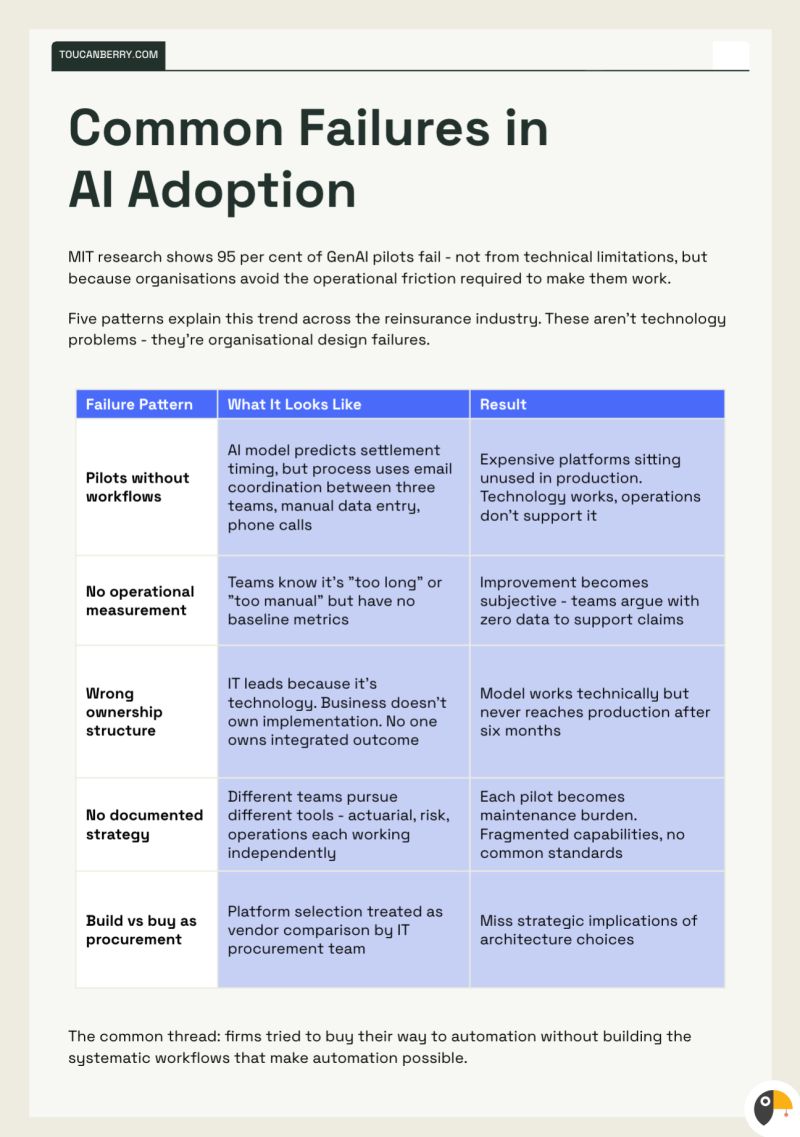
The reinsurance industry faces a paradox. The same companies that expertly model complex risk scenarios for clients regularly fail to successfully implement their own internal systems.
Consider these all-too-common scenarios:
- A treaty management system implemented without mapping how treaties actually flow through the organisation
- A risk analytics platform launched without connecting to live deal flows
- A settlement automation tool that still requires manual data preparation
In each case, the projects deliver ‘outputs’ without improving the actual decisions or workflows they’re meant to support.
The result? Digital facades atop manual processes. New user interfaces that end up slowing down experienced actuaries. And dashboards filled with data nobody trusts.
The wrong incentive structure
This pattern persists because the incentives are fundamentally misaligned across all stakeholders:
Internal IT teams: Success means shipping a project to specification, not driving adoption or business outcomes. They’re rewarded for delivery, not impact.
Big consultancies: Longer projects mean more billable hours. Complexity is financially rewarded, simplicity is not.
Software vendors: The goal is to sell more modules and licences, not to solve the core operational problem.
Frontline users: There’s little reward for adopting new systems that disrupt established processes, especially if they’re not involved in the design.
Research consistently shows that around 70% of technology transformations fail to meet their objectives. Not because the technology isn’t capable, but because the foundation is flawed.
The problem-solution disconnect
In our work with reinsurers, we’ve identified three critical disconnects that guarantee project failure:
1. Starting with systems, not workflows
Leadership identifies a broad goal (e.g. “improve treaty management”), teams jump straight to evaluating platforms and vendors, and the actual flow of work is barely considered. Systems get purchased based on features, not fit with how work actually happens.
2. Confusing outputs with outcomes
Most project requirements focus on what the system should produce (reports, dashboards, interfaces) rather than what should improve (speed, accuracy, decision quality). “Success” becomes delivering the specified outputs by the deadline, regardless of whether those outputs actually change how the business operates.
3. Hiding operational complexity
Reinsurance operations are complex, often messy, and highly interconnected. Data flows across departments with varying quality standards, reconciliation points, and manual interventions. But executives and vendors prefer the clean simplicity of system diagrams over the messy reality of how work actually gets done.
The hidden costs
The costs of these failures extend far beyond wasted project budgets:
- Opportunity cost: While competitors advance, reinsurers remain stuck with operational inefficiencies
- Trust erosion: Every failed project makes the next one harder as organisational skepticism grows
- Capability atrophy: When good people spend time working around bad systems, their skills focus on navigating complexity rather than creating value
This explains why digital transformation in reinsurance often feels like wading through treacle — lots of stuff happening, with minimal real progress.
Breaking the cycle
Next week, we’ll explore how to break the doom cycle and build technology that actually delivers operational advantage. We’ll share the approaches that have helped reinsurers transform their operations without the traditional pitfalls, including three proven methodologies that address the root causes of IT project failure.