
The first in a series examining what this year’s Captive Conference revealed about the industry’s next chapter
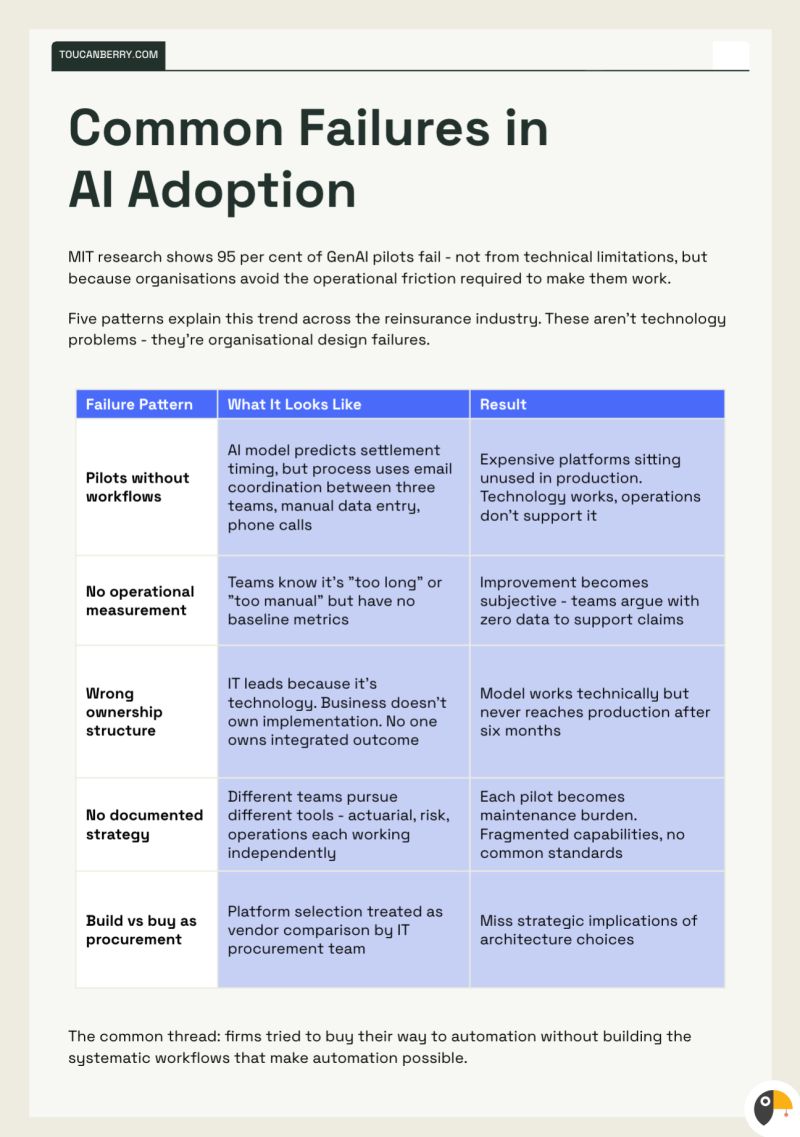
Bermuda’s captive industry manages £1.6 trillion in assets through some of the world’s most sophisticated risk frameworks. But across conversations at the conference, it became clear that many operations still run on workflows that wouldn’t look out of place in 2005.
- Actuaries manually rekeying data between systems.
- Settlement processing taking days when it should take minutes.
- Critical pricing decisions buried in undocumented spreadsheets.
The honesty from speakers was refreshing. So was the growing appetite for change.
The operational reality
What we consistently observe in life and annuity reinsurance was reflected in conference discussions — firms capable of modelling longevity or asset-intensive risks with precision still move data between systems manually.
The positive news: there’s such willingness to address these problems systematically rather than accept them as inevitable.
The conversation has shifted from “that’s just how reinsurance works” to “how should reinsurance work?”
This represents a fundamental change in mindset.
Why change is accelerating
Three forces are driving urgency:
Workforce pressure. With significant retirements approaching and competition for skilled professionals intensifying, the traditional response of adding headcount faces practical limits.
Hard market conditions. When premium volumes increase rapidly, manual processes that worked at smaller scale become bottlenecks. Spreadsheets slow onboarding by weeks, risking lost revenue to faster competitors.
Private equity ownership. PE-backed firms need to demonstrate scalability — growth that doesn’t require proportional increases in operational costs.
Industry readiness
What we heard consistently emphasised solutions that amplify existing expertise rather than replace it. There’s strong interest in proven approaches over experimental tech.
In Bermuda’s concentrated market, pilot projects don’t stay secret for long — which means firms need solutions that have a high probability of working.
This echoes our experience working with reinsurers on the island. In one recent example, we enabled a settlement workflow that used to take three days and now runs in under 30 minutes with full traceability.
What this means for data architecture
The challenge isn’t technology availability — most needed capabilities already exist. The constraint is data structure and workflow integration.
Bermuda’s audit trail requirements and data governance standards mean any operational change must strengthen compliance frameworks, not compromise them — this favours systematic approaches over quick fixes.
The path forward
What we observed was an industry that now recognises operational sophistication as a genuine differentiator. Not through technology for its own sake, but through auditable, shared logic that eliminates friction and scales expertise.
The question isn’t whether operational modernisation will happen in Bermuda’s captive industry — the shift is already underway.
The real question is: who will lead, and who will wait and be forced to rebuild under pressure?
If you’re dealing with spreadsheet sprawl, legacy handoffs, or coordination bottlenecks, you’re not alone. We help Bermuda reinsurers design systems that scale without scaling headcount.