
Part two in our series on what the Bermuda Captive Conference revealed about the industry’s operational evolution
Last week, we explored how Bermuda’s captive industry is recognising operational realities. The appetite for change is there — but so is the challenge of proving business value.
During the disruptive technology panel, panellists tackled the question every operational discussion eventually faces: how do you actually demonstrate return on investment?
What we heard reinforced something we consistently see — the difficulty of connecting operational improvements to clear business outcomes.
Focus on numbers that show up in quarterly results
The ROI conversation comes down to numbers that show up in quarterly results.
Consider treaty management workflows.
Most captives still handle contract terms and obligations through scattered PDFs, emails, and shared drives. Critical information — renewal dates, rate changes, claim limits, notification windows — lives buried in documentation rather than actively managed.
When we help clients build centralised treaty libraries that capture key terms in structured, searchable formats, teams eliminate hours of weekly document searching and gain instant access to structured information for operational decisions. Missed deadlines decrease significantly.
Bermuda has exceptional talent — the challenge is ensuring they’re working on problems that utilise their expertise rather than manual coordination tasks.
Why compound effects matter more than time savings
What emerged from conference discussions was sophisticated understanding that operational improvements compound differently in captive operations.
Better data structure doesn’t just save time — it eliminates error risk that cascades between teams. When critical business information moves manually between actuarial, finance, and operations groups, version control issues multiply and reconciliation errors can delay quarterly reporting.
In one recent client implementation, we automated data exchange workflows with parent companies and asset managers. Previously, teams spent significant time chasing missing submissions, validating file integrity, and manually triggering downstream processes. Now over 7,000 files flow through secure, automated platforms with complete audit trails.
Processing delays from missing or misdirected files were eliminated entirely. Same-day processing became standard.
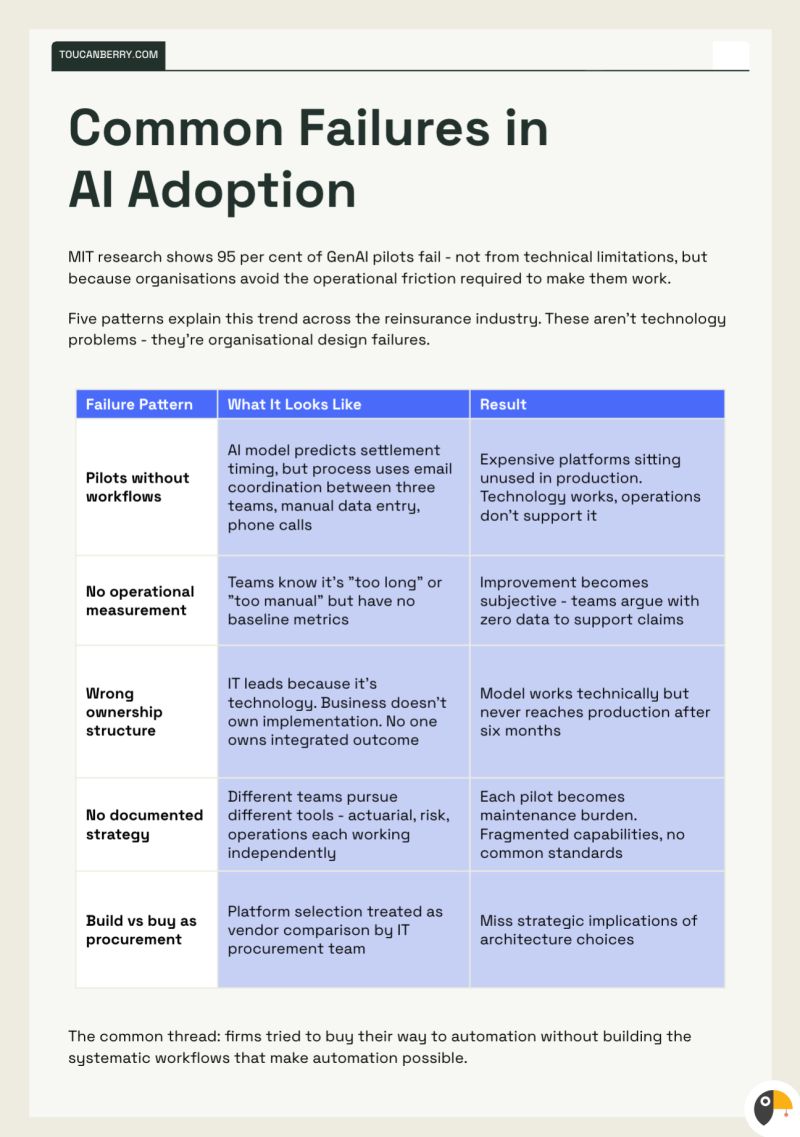
Technology isn’t the limiting factor
To make real progress, treat operational improvement as competitive advantage, not cost management. Measure:
- Portfolio growth per employee, not cost per transaction.
- Time-to-market for new business lines, not system uptime.
- Risk reduction alongside efficiency gains — compliance strengthening, not just processing speed.
The real constraint is how well existing systems connect and share data. One life reinsurer we worked with initially staffed up their finance function with each new treaty, but after implementing structured data flows between their pricing, underwriting, and accounting systems, they’re now handling triple the business volume with the same team size while improving reporting accuracy by 40%.
Each improvement makes the next one easier
The key is building operational architecture that creates compounding advantages.
Each improvement makes the next one easier. Each new capability strengthens existing ones. Each efficiency gain enables higher-value work rather than just cost reduction.
If you’re working to prove the business case for operational improvements, we’d be interested to hear your approach. We help Bermuda reinsurers design operational architecture that delivers measurable business outcomes.