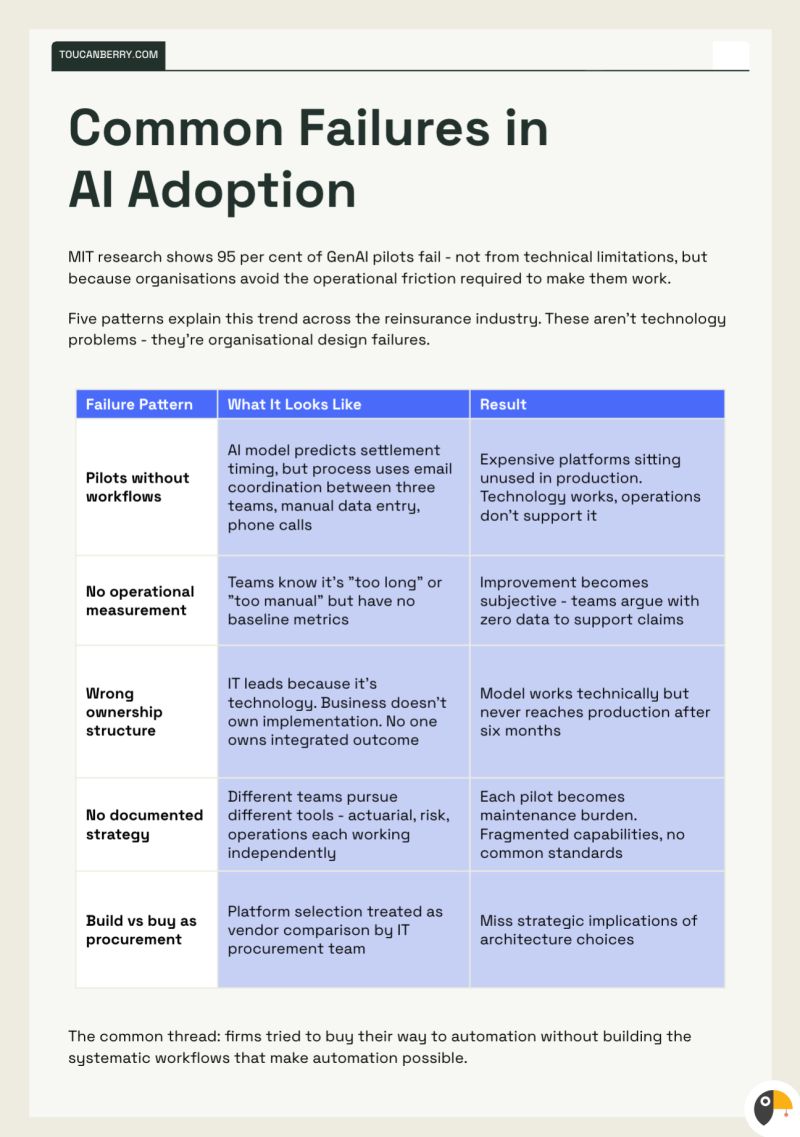

We’re seeing AI work in demos but fall apart when used for real business.
3 insurers made it work — here’s how.
Zurich Insurance deployed an agentic AI platform in Commercial Insurance that compresses document handling from hours to minutes. They’re targeting a step-change in quote throughput and renewals productivity. It works because the AI is embedded in the underwriting workflow, not a separate system. The data and workflow were already systematic.
Aon Impact Forecasting uses AI to generate stochastic event sets for tropical cyclones and drive automated event-day loss estimation. The outputs flow straight into pricing, exposure management, and claims prioritisation because the operational plumbing — data standards, live ingestion, predefined decision points — was already in place.
Swiss Re deployed ClaimsGenAI for automated claims analysis, identifying millions in potential fraud savings in the first year.
These applications succeed because the operational foundations — data standards and systematic workflows — were already in place.
The lesson is the same across all three: when data is structured and workflows are systematic, AI delivers measurable results.
Life reinsurance isn’t catastrophe modelling. But the principle is identical — when data lineage and workflows are defined, AI delivers usable outputs at business speed.
Most firms only discover their operational gaps when AI implementation starts. Systems can’t talk to each other. Data doesn’t flow cleanly. Pilots that worked in isolation fail in production.
The common thread: they fixed operations before buying tools. Data actually flowed between systems. Workflows were mapped and systematic. Someone owned the outcome.
Read our AI Readiness in Bermuda Life Reinsurance report for more.